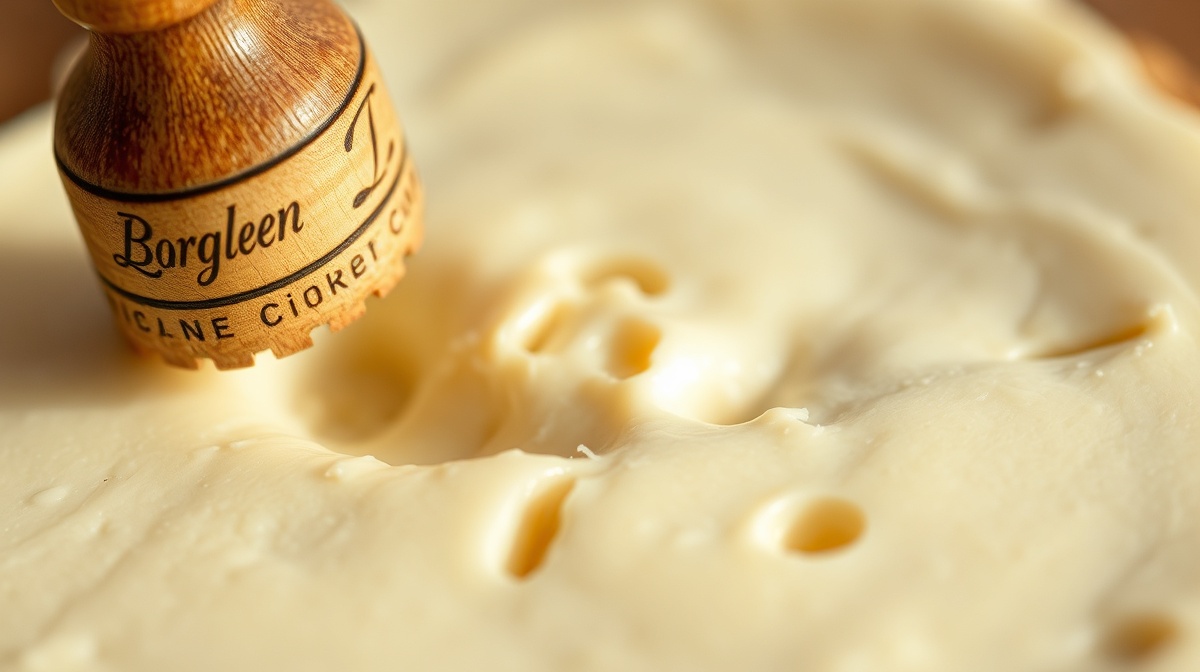
At the Alkmaar Saturday market, customers regularly pick up one of our belegen wheels, look at the small stamp pressed into the rind, and ask what it means. The usual assumption is that it is a quality mark — something like an appellation d'origine contrôlée, or at least an indication that the cheese is premium. It is not exactly wrong, but it is not quite right either.
The boerenkaasmerk — literally "farmhouse cheese mark" — is a registered certification mark administered by the Stichting Boerenkaas. What it certifies is a production method, and the method is defined quite precisely.
What the mark requires
To stamp a wheel with the boerenkaasmerk, the cheese must meet all of the following:
- The milk must come from the producer's own herd. You cannot buy in milk from a neighbouring farm, even if that farm meets the same standards. The mark certifies a direct connection between the animals and the cheese. A dairy that processes milk from multiple farms cannot use it, regardless of quality.
- The milk must be processed within 40 hours of milking. This limits the accumulation of psychrotrophic bacteria during cold storage and ensures the cheese reflects the milk's fresh composition.
- The cheese must be made on the farm where the milk was produced. Transport to an off-farm processing facility breaks the chain the mark is intended to represent.
- The production must follow traditional methods as defined in the certification body's technical specification — hand or mechanical pressing (not continuous belt press systems), natural rind formation, no artificial rind treatments beyond the permitted wax or coating types.
The mark does not certify: organic production, raw milk use, a particular flavour profile, or a minimum aging period beyond what the cheese type normally requires. A boerenkaasmerk Gouda can legally be made from pasteurised milk. Most are.
Why this matters to us specifically
We applied for the mark in 2012, three years after we started making cheese. I had initially assumed it was primarily a marketing tool and was uncertain whether the certification overhead was worth it for our scale. After reading the technical specification more carefully, I realised the mark was describing exactly how we were already working — same-farm milk, processed fresh, traditional methods — and that the annual certification audit would give us a useful external check on our process documentation.
The annual audit is conducted by an independent inspector appointed by the Stichting. It covers record-keeping (milk intake times, batch logs, temperature records), facility condition, and a spot-check of the stamp application process. In sixteen years we have had one corrective action — in 2018, the inspector found that our batch numbering system had a gap that made one batch's milk intake time unverifiable. We fixed the logging template and have had clean audits since.
What customers understand
The nuance of "production method certification" does not travel well across a market stall. Most customers hear "farmhouse mark" and conclude it means small-scale, high-quality, and probably organic. Two out of three of those inferences are correct for our cheese. The organic assumption is not — we use conventional veterinary treatment when animals need it, and we do not hold organic certification.
I have stopped trying to explain the full definition at the market. The shorter version — "it means the milk came from our cows and we made the cheese on this farm, by hand" — is accurate enough and does not require a discussion of EU Regulation 853/2004 while someone is waiting for their turn at the herring stall.
But I think the precise definition is worth knowing if you are interested in where food comes from. The mark is a traceability instrument as much as a quality signal. It means that the wheel you are holding can be connected, through the audit trail, to specific milkings from a specific herd on a specific registered farm. In a food system where provenance is frequently obscured, that connection is not a small thing.