My name is Maaike van der Hoeven. My husband Pieter and I run a small dairy on eight hectares of reclaimed polder land about six kilometres west of Alkmaar. We keep twenty-two Frisian-Holstein cows, a handful of chickens that earn their keep poorly, and one dog that earns his keep not at all.
I grew up in this farmhouse. My grandfather bought it in 1961 when the land was still leased from the Hoogheemraadschap. He kept dairy cows but sold everything to the cooperative — there was no such thing as artisan cheese in the area then, or at least no one called it that. My parents switched to arable farming in the nineties when the milk quota made a small herd uneconomical.
Pieter and I moved back in 2007. He had been working in logistics in Rotterdam; I had been teaching secondary-school biology in Haarlem. We both wanted to stop commuting. The cows came in 2008. The cheese licence came in 2009, after a long argument with the municipality about the production space drainage requirements, which I will spare you.
Why raw milk
The honest answer is stubbornness. When we applied for the cheesemaker registration, our dairy adviser strongly suggested pasteurising. The liability is lower, the inspection regime is simpler, the shelf life is longer. All true.
But the milk our cows produce in May — when the grass is young and the butterfat is running at 4.1% — tastes of something. Pasteurisation does not destroy everything, but it softens the volatile compounds that make the difference between a technically correct cheese and one that you remember. I was not willing to start by removing the best part of what we had.
We have passed every NVWA inspection since opening. We test each batch before release. Raw milk is not dangerous if you are careful; it is only demanding.
The cellar
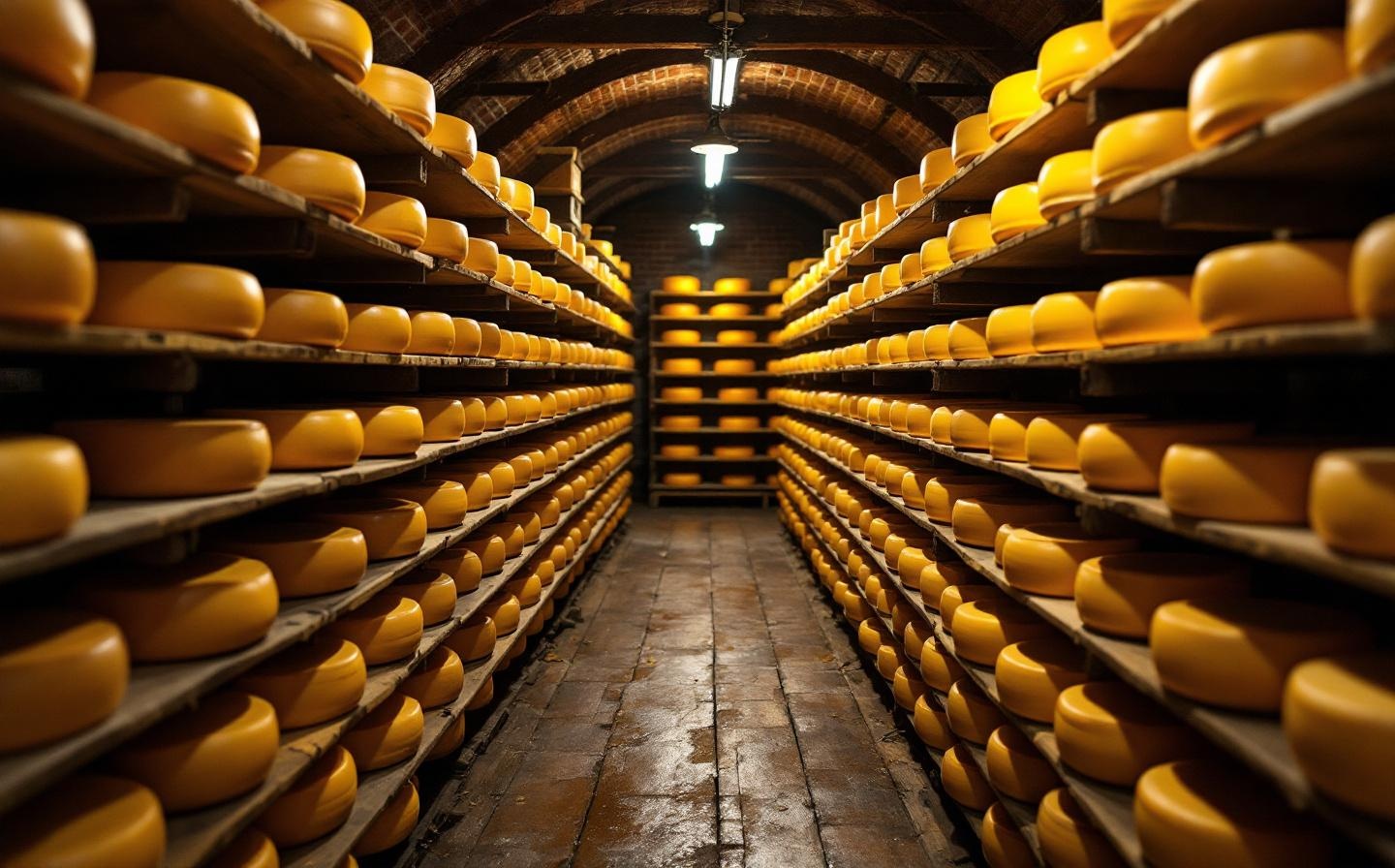
The aging cellar is under the barn, dug in the 1880s for potato storage. The floor is original brick. The walls sweat slightly in autumn, which keeps the humidity between 88 and 92 percent without any mechanical assistance — exactly what a ripening Gouda wants. We added electric lighting and a small temperature monitor in 2013. Otherwise it is as it was.
We age on Dutch pine boards, rubbed with brine before each new batch. I know cheesemakers who have switched to HDPE boards because they are easier to clean and food-safe inspectors raise fewer eyebrows. Our cellar culture — the particular mix of moulds and bacteria that live on those boards and in the brickwork — contributes to the rind and to the interior flavour in ways we have not been able to replicate on plastic. We keep the pine.
The animals
Twenty-two cows is a deliberately small number. We could run forty on this land. With forty, I would need a full-time employee and I would need to mechanise the pressing. With twenty-two, Pieter and I can manage everything ourselves during most of the year, and we know each animal individually well enough to notice when something is off before it becomes a problem.
The herd goes outside from late March until November, weather permitting. They overwinter in the barn on a deep-litter system that is composted and spread on the pasture in spring. We buy no synthetic fertiliser. The land is not certified organic — the certification costs and the constraint on conventional veterinary treatment if an animal is genuinely sick are not trade-offs I am willing to make — but our practices are consistent with it.
This journal
I started writing here in 2022, mostly to keep a record for myself. Cheese production is full of variables that interact in ways that are hard to track without notes: weather, grass composition, batch timing, rennet lot numbers, cellar humidity cycles. The journal became a way to correlate observations across seasons.
I write about things that surprised me, things that went wrong, and occasionally things that worked better than expected. If you are a cheesemaker yourself, some of it may be useful. If you just like cheese, I hope it is at least readable.
You can reach me at maaike [at] kaashoeve.top. I try to reply within a week, though in May and September I am usually behind on everything.