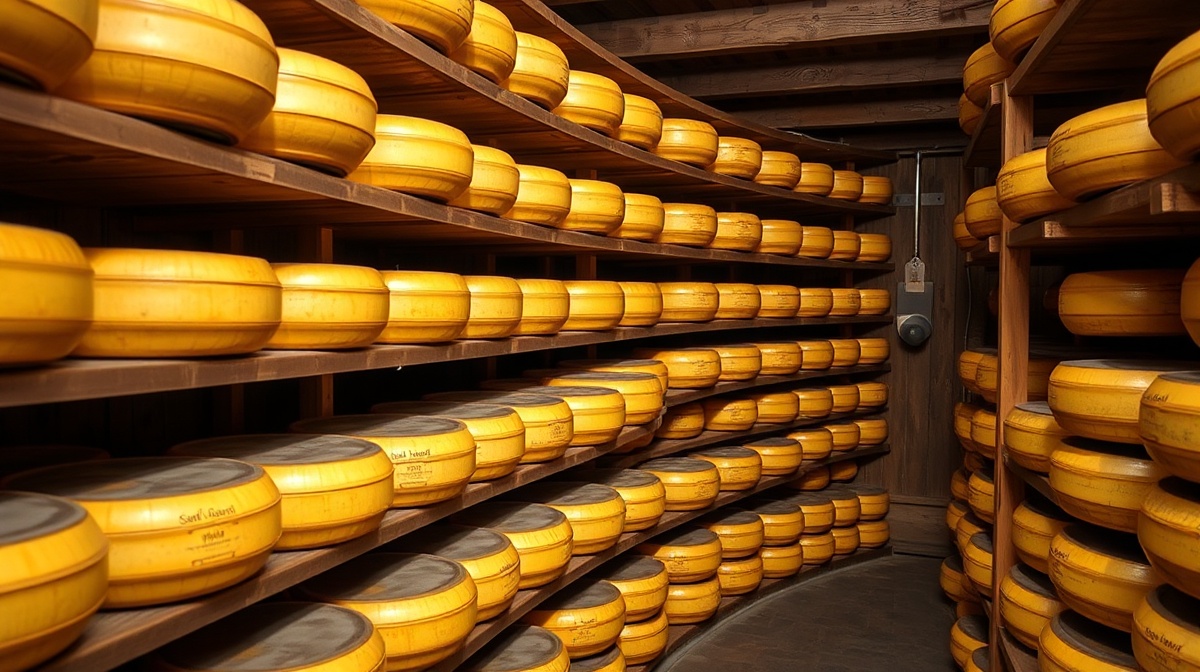
In the spring of 2024 our dairy adviser suggested we trial HDPE shelving boards in one section of the cellar. His reasoning was straightforward: pine boards harbour bacteria. The brine rubbing we do between batches reduces contamination but does not eliminate it. HDPE is non-porous, steam-cleanable, and food-safe inspectors do not look at it twice. It was a sensible suggestion and we tried it properly — two full batches on HDPE, two on pine, tracked in parallel across the same cellar section.
We finished the comparison in October 2025 and went back to pine. Here is what we found.
The experiment
We ran the HDPE boards alongside the existing pine boards from April through October 2024, using the same milk, the same culture, and the same brine solution. Each board type held eighteen wheels of our belegen (target age: 16 weeks). We flipped wheels on the same schedule — every three days for the first month, weekly after that. The cellar conditions were consistent: 12–14 °C, 88–92% relative humidity.
We tracked three things:
- Rind development — colour, texture, and absence of cracks at 8 and 16 weeks
- Weight loss at 16 weeks (a rough proxy for moisture migration through the rind)
- Flavour at 16 weeks — informal tasting with Pieter, our neighbour Jan (who has been eating our cheese for twelve years and has strong opinions), and myself
It is not a controlled scientific trial. We did not send samples to a flavour laboratory. But we know our cheese well enough to spot a meaningful difference.
What the HDPE boards produced
The rinds on the HDPE batch were paler and more uniform. Where pine-aged wheels typically develop a mottled ochre surface with some variation across the face — slight darkening near the edges, occasional light bloom of Penicillium candidum that we brush off — the HDPE wheels came out a fairly even yellow-cream. Technically fine. Visually correct. Texturally a little smoother than I expect.
Weight loss at 16 weeks averaged 8.4% on HDPE versus 9.1% on pine. The difference is small, but it suggests the rind on the HDPE batch was slightly less permeable — which means less moisture migration and, almost certainly, less gas exchange during aging.
The flavour tasting was where the gap was clearest. The pine-aged wheels at 16 weeks had the buttery-to-caramel transition we expect around the 10-week mark and a mild sharpness that develops in the final month. The HDPE wheels were milder, more one-dimensional. Jan described the HDPE batch as "supermarket cheese, but made by someone who knows what they are doing." That was not intended as a compliment.
What we think is happening
Pine boards are not neutral. They carry a community of micro-organisms — mainly various Brevibacterium, Staphylococcus, and yeast species — that colonise the rind surface during the early weeks of aging. Some of these contribute directly to flavour via proteolysis and lipolysis in the outer layer of the paste. Others produce CO₂ and various volatile compounds that influence the rind texture and aroma.
HDPE provides none of this. The surface is colonised solely by whatever is in the air and the brine — which in our cellar is dominated by the same culture, but without the inoculation boost from the board itself. The result is a technically safe rind that does less flavour work.
What we changed
We removed the HDPE boards and returned the section to pine in November 2024. We also started keeping more detailed records of board age and brine concentration per batch — partly as a result of paying closer attention during the trial.
If I were starting a new cheese operation from scratch I might make a different decision. The regulatory environment around wooden boards in cheese production is tightening in some EU member states, and the cleaning overhead is real. But for a cellar that has been running the same microbial community for fifteen years, the pine boards are not just storage furniture — they are part of the process.
The HDPE boards are now in the barn, holding seed potatoes. They are very easy to clean.